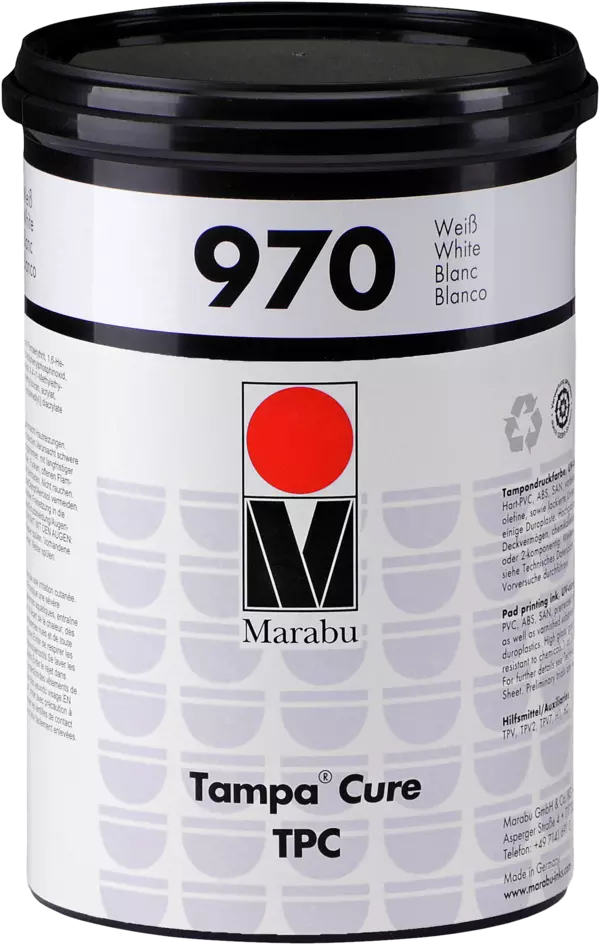
Tampa® Cure TPC.
Efficient thanks to fast-curing UV ink
Tampa Cure TPC is a UV-curing pad printing ink suitable for technical markings,
audio and electrical items, among other things. It cures quickly and can be post-processed immediately.
- Versatile use for practically all pad printing machines and printing speeds
- Brilliant color shades with high opacity
- Time saving thanks to immediate UV-curing
- Excellent resistance to mechanical stress and chemicals
Substrates:
- Metals
- ABS
- Acrylic glass (PMMA)
- Polystyrene (PS)
- PVC, rigid
- Polyamide (PA)
- Polycarbonate (PC)
- Polyethylene (PE), pretreated
- Polypropylen (PP), pretreated
Highlights:
- For immediate post-processing of the printed products
- Suited for practically all pad printing machines, printing speeds, and open or closed ink systems
- Quality and process safety
- Excellent appearance
- For a wide range of substrates
Opaque White
Opaque Black
Overprint Varnish
Light Yellow
Orange
Scarlet Red
Carmine Red
Ultramarine Blue
Brilliant Blue
White
Black
38190057170
38190057180
38190057910
38190057922
38190057926
38190057932
38190057934
38190057952
38190057956
38190057970
38190057980
- High Opaque Shades170
Opaque White
180Opaque Black
Further Products910Overprint Varnish
Basic Shades922Light Yellow
926Orange
932Scarlet Red
934Carmine Red
952Ultramarine Blue
956Brilliant Blue
970White
980Black
Opaque White 170, 1 kg
38190057170Opaque Black 180, 1 kg
38190057180Overprint Varnish 910, 1 kg
38190057910Light Yellow 922, 1 kg
38190057922Orange 926, 1 kg
38190057926Scarlet Red 932, 1 kg
38190057932Carmine Red 934, 1 kg
38190057934Ultramarine Blue 952, 1 kg
38190057952Brilliant Blue 956, 1 kg
38190057956White 970, 1 kg
38190057970Black 980, 1 kg
38190057980
Properties:
- Pad printing ink for ABS, rigid PVC, some PC, PS, and PMMA materials, pre-treated PE and PP, PA as well as some metals, and varnished surfaces
- UV-curable, high gloss, good opacity, 1- or 2-component ink system, resistant to chemicals
Substrates:
- Metals
- ABS
- Acrylic glass (PMMA)
- Polystyrene (PS)
- PVC, rigid
- Polyamide (PA)
- Polycarbonate (PC)
- Polyethylene (PE), pretreated
- Polypropylen (PP), pretreated
Auxiliaries:
| TPV2 | Thinner | 5 - 15 % |
| TPV | Thinner | 5 - 10 % |
| TPV7 | Thinner | 5 - 10 % |
| OP170 | Opaquing Paste | 0 - 15 % |
| H4 | Hardener | 0 - 10 % |
| H1 | Hardener | 5 % |
| H2 | Hardener | 5 % |
| HX | Hardener | 5 % |
| SA1 | Surface Additive | 3 - 5 % |
| MP | Matting Powder | 2 - 3 % |
| UV-B1 | UV Accelerator | 1 - 2 % |
| UV-HV7 | Adhesion Modifier | 0 - 5 % |
| UV-VM | Levelling Agent | 0 - 1 % |
| P2 | Primer | |
| UR3 | Cleaner (flp. 42°C) | |
| UR4 | Cleaner (flp. 52°C) | |
| UR5 | Cleaner (flp. 72°C) |
Ink adjustment:
The ink should be stirred homogeneously before printing and if necessary during production.
Tampa Cure TPC is not press-ready and must therefore be adjusted to the required viscosity with the corresponding thinners prior to printing. In the case of higher requirements to the ink’s resistance or reactivity, there are different additives available.
Using TPC as a 2-component ink
According to the substrate and the required ink characteristics, it is possible to add hardener to Tampa Cure TPC before printing. Required quantity to be added see "Auxiliaries".
Pre-reaction time
It is recommended to allow the ink/hardener mixture to pre-react for 15 min.
Pot life
The ink/hardener mixture is chemically reactive and must be processed within 12-16 h (referred to 20-25 °C and 45-60 % RH). Higher temperatures reduce the pot life. If the mentioned times are exceeded, the ink's adhesion and resistance may be reduced even if the ink still seems processable.
When using hardener, the processing and curing temperature must not be lower than 15 °C as irreversible damage can occur. Please also avoid high humidity for several hours after printing as the hardener is sensitive to humidity.
Drying:
Tampa Cure TPC contains solvents. Parallel to physical drying and the evaporation of the sol-vents used, the actual hardening of the ink film is caused by a chemical cross-linking reaction started by the UV-light.
Tampa Cure TPC is a slightly post-curing UV ink which will achieve its best resistances after 24 h. If hardener was added, the curing speed will be reduced. Due to this, adhesion and scratch resistance should be tested only after 24 h. A final curing of the ink film will be reached after approx. 48 h.
UV-Curing
According to the required curing speed, a UV-curing unit (medium-pressure mercury lamps) of 100-140 W/cm is necessary.
The curing speed of the ink is generally dependant upon the kind of UV-curing unit (reflectors), number, age, and power of the UV-lamps, the printed ink film thickness, colour shade, substrate in use, as well as the printing speed. The adhesion of the ink is usually tested by a tape test after the ink film has cooled down to room temperature (approx. 20 °C).
As with all UV-curable printing inks, the presence of residual monomers and photoinitiators' decomposition products cannot be completely ruled out even after sufficient curing. If these traces are relevant for the application, this must be taken into account in individual cases, as this depends on the actual printing and curing conditions.
Printing parameters:
Clichés
All commercially available clichés made of ceramic, photopolymer, thin steel, and chemically hardened steel (10 mm) can be used. The recommended cliché depth is 16-22 µm.
Printing pads
As per our experience, all common printing pads consisting of materials cross-linked by condensation or addition can be used.
Printing machines
Tampa Cure TPC is suited for closed ink cup systems as well as for open ink wells. As for solvent-based ink types, a certain quantity of thinner should be added during longer print runs in order to control the ink’s viscosity.
- Metals
- ABS
- Acrylic glass (PMMA)
- Polystyrene (PS)
- PVC, rigid
- Polyamide (PA)
- Polycarbonate (PC)
- Polyethylene (PE), pretreated
- Polypropylen (PP), pretreated
- For immediate post-processing of the printed products
- Suited for practically all pad printing machines, printing speeds, and open or closed ink systems
- Quality and process safety
- Excellent appearance
- For a wide range of substrates
Substrates:
Highlights:
High reactivity, fast curingVersatile useVery resistant to chemicals, and mechanical stressBrilliant colour shades with high opacityCan be used as 1- or 2-component ink- High Opaque Shades170
Opaque White
180Opaque Black
Further Products910Overprint Varnish
Basic Shades922Light Yellow
926Orange
932Scarlet Red
934Carmine Red
952Ultramarine Blue
956Brilliant Blue
970White
980Black
Opaque White 170, 1 kg
38190057170Opaque Black 180, 1 kg
38190057180Overprint Varnish 910, 1 kg
38190057910Light Yellow 922, 1 kg
38190057922Orange 926, 1 kg
38190057926Scarlet Red 932, 1 kg
38190057932Carmine Red 934, 1 kg
38190057934Ultramarine Blue 952, 1 kg
38190057952Brilliant Blue 956, 1 kg
38190057956White 970, 1 kg
38190057970Black 980, 1 kg
38190057980
Available in these sizes / volumesHigh Opaque Shades170Opaque White
180Opaque Black
Further Products910Overprint Varnish
Basic Shades922Light Yellow
926Orange
932Scarlet Red
934Carmine Red
952Ultramarine Blue
956Brilliant Blue
970White
980Black
Opaque White 170, 1 kg
38190057170Opaque Black 180, 1 kg
38190057180Overprint Varnish 910, 1 kg
38190057910Light Yellow 922, 1 kg
38190057922Orange 926, 1 kg
38190057926Scarlet Red 932, 1 kg
38190057932Carmine Red 934, 1 kg
38190057934Ultramarine Blue 952, 1 kg
38190057952Brilliant Blue 956, 1 kg
38190057956White 970, 1 kg
38190057970Black 980, 1 kg
38190057980- Pad printing ink for ABS, rigid PVC, some PC, PS, and PMMA materials, pre-treated PE and PP, PA as well as some metals, and varnished surfaces
- UV-curable, high gloss, good opacity, 1- or 2-component ink system, resistant to chemicals
- Metals
- ABS
- Acrylic glass (PMMA)
- Polystyrene (PS)
- PVC, rigid
- Polyamide (PA)
- Polycarbonate (PC)
- Polyethylene (PE), pretreated
- Polypropylen (PP), pretreated
Properties:
Substrates:
Auxiliaries:
TPV2 Thinner 5 - 15 % TPV Thinner 5 - 10 % TPV7 Thinner 5 - 10 % OP170 Opaquing Paste 0 - 15 % H4 Hardener 0 - 10 % H1 Hardener 5 % H2 Hardener 5 % HX Hardener 5 % SA1 Surface Additive 3 - 5 % MP Matting Powder 2 - 3 % UV-B1 UV Accelerator 1 - 2 % UV-HV7 Adhesion Modifier 0 - 5 % UV-VM Levelling Agent 0 - 1 % P2 Primer UR3 Cleaner (flp. 42°C) UR4 Cleaner (flp. 52°C) UR5 Cleaner (flp. 72°C) Ink adjustment:
Recommendation
The ink should be stirred homogeneously before printing and if necessary during production.
Tampa Cure TPC is not press-ready and must therefore be adjusted to the required viscosity with the corresponding thinners prior to printing. In the case of higher requirements to the ink’s resistance or reactivity, there are different additives available.
Using TPC as a 2-component ink
According to the substrate and the required ink characteristics, it is possible to add hardener to Tampa Cure TPC before printing. Required quantity to be added see "Auxiliaries".Pre-reaction time
It is recommended to allow the ink/hardener mixture to pre-react for 15 min.
Pot life
The ink/hardener mixture is chemically reactive and must be processed within 12-16 h (referred to 20-25 °C and 45-60 % RH). Higher temperatures reduce the pot life. If the mentioned times are exceeded, the ink's adhesion and resistance may be reduced even if the ink still seems processable.
When using hardener, the processing and curing temperature must not be lower than 15 °C as irreversible damage can occur. Please also avoid high humidity for several hours after printing as the hardener is sensitive to humidity.Drying:
Tampa Cure TPC contains solvents. Parallel to physical drying and the evaporation of the sol-vents used, the actual hardening of the ink film is caused by a chemical cross-linking reaction started by the UV-light.
Tampa Cure TPC is a slightly post-curing UV ink which will achieve its best resistances after 24 h. If hardener was added, the curing speed will be reduced. Due to this, adhesion and scratch resistance should be tested only after 24 h. A final curing of the ink film will be reached after approx. 48 h.
UV-Curing
According to the required curing speed, a UV-curing unit (medium-pressure mercury lamps) of 100-140 W/cm is necessary.
The curing speed of the ink is generally dependant upon the kind of UV-curing unit (reflectors), number, age, and power of the UV-lamps, the printed ink film thickness, colour shade, substrate in use, as well as the printing speed. The adhesion of the ink is usually tested by a tape test after the ink film has cooled down to room temperature (approx. 20 °C).
As with all UV-curable printing inks, the presence of residual monomers and photoinitiators' decomposition products cannot be completely ruled out even after sufficient curing. If these traces are relevant for the application, this must be taken into account in individual cases, as this depends on the actual printing and curing conditions.Printing parameters:
Clichés
All commercially available clichés made of ceramic, photopolymer, thin steel, and chemically hardened steel (10 mm) can be used. The recommended cliché depth is 16-22 µm.Printing pads
As per our experience, all common printing pads consisting of materials cross-linked by condensation or addition can be used.Printing machines
Tampa Cure TPC is suited for closed ink cup systems as well as for open ink wells. As for solvent-based ink types, a certain quantity of thinner should be added during longer print runs in order to control the ink’s viscosity.
CONTACT US
Marabu printing inks are used all over the world - with 16 subsidiaries worldwide and distribution partners in more than 80 countries. Find your contact here.