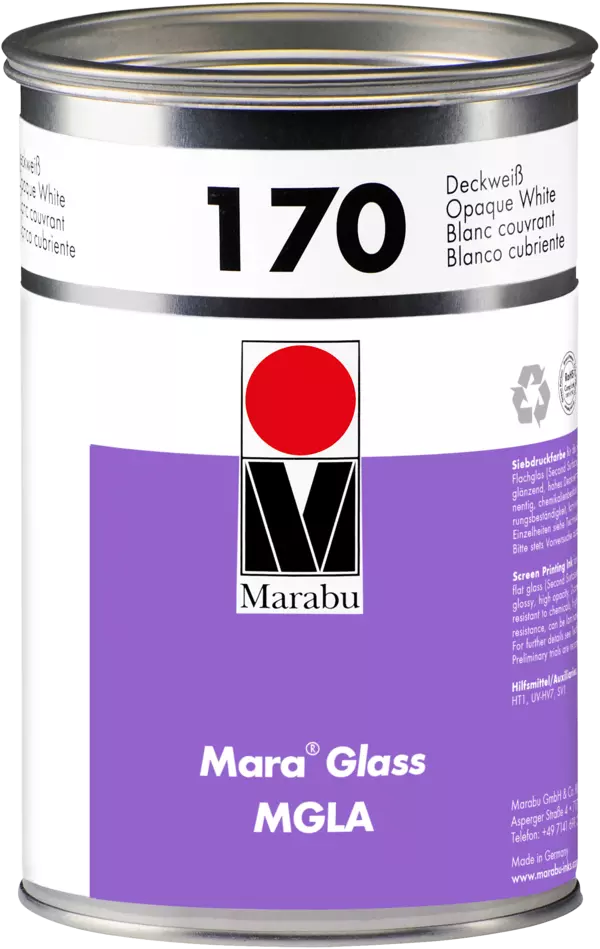
Mara® Glass MGLA.
Impervious ink to weather conditions
The screen printing ink Mara® Glass MGLA is used for second surface decoration on glass for flat input systems used outside, or partly outside. This may include intercommunication systems, ship control systems, or vending machines. Solvent-based and two-component.
- Excellent for outdoor applications
- Suitable for lamination with very good bonding properties
- Good temperature resistance
- High opacity
Substrates:
- Glass
Industry solution for:
Highlights:
- Very high light fastness and weather resistance
- Most minimal colour shift after 5.000 h weathering (< 1 dE)
- No yellowing or fading!
- Silicone-free
- Good bonding properties
- Good temperature resistance
- Non-conductive opaque black
- Resistant to MEK and acetone
- Adhesive resistance
- Homogeneous ink film
Opaque White
Opaque Black
33680057170
33680057180
- High Opaque Shades170
Opaque White
180Opaque Black
Opaque White 170, 1 kg
33680057170Opaque Black 180, 1 kg
33680057180
Properties:
- Solvent-based baking ink for printing onto flat glass (Second Surface)
- Silicone-free, glossy, high opacity, 2-component ink system, resistant to chemicals, high weather resistance, suitable for lamination
Substrates:
- Glass
Auxiliaries:
| PV | Thinner | 10 - 20 % |
| SV1 | Retarder | 10 - 15 % |
| HT1 | Hardener | 10 % |
| UV-HV7 | Adhesion Modifier | 10 % |
| VM1 | Levelling Agent | 0.5 - 2 % |
| UR3 | Cleaner (flp. 42°C) | |
| UR4 | Cleaner (flp. 52°C) | |
| UR5 | Cleaner (flp. 72°C) |
Ink adjustment:
If cleaning is carried out with automatic screen washing systems, we recommend prior to printing an additional manual cleaning with a fresh cleaner not having had any contact with ink residues containing silicone.
Drying:
Parallel to physical drying, i. e. the evaporation of the solvents used, the actual hardening of the ink film is caused by the chemical crosslinking reaction between ink and hardener. The drying times vary according to substrate, ink deposit, humidity, drying conditions, and the auxiliaries used.
For multi-colour printing, please note that the previously printed ink films should not be entirely cured before the consecutive ink film is printed on it. Only after all ink films have been applied, they should be baked.
The following values, related to the object temperature, concerning progressive cross-linking reactions (hardening) of the ink film (thickness 4 -12 µ) are recommended:
Intermediate drying: Overprintable after 3-5 min. / 160 -170°C
Final drying: 20 - 30 min. / 180 - 200°C
Printing parameters:
- Glass
- Very high light fastness and weather resistance
- Most minimal colour shift after 5.000 h weathering (< 1 dE)
- No yellowing or fading!
- Silicone-free
- Good bonding properties
- Good temperature resistance
- Non-conductive opaque black
- Resistant to MEK and acetone
- Adhesive resistance
- Homogeneous ink film
Substrates:
Industry solution for:
"Second surface" outdoor applications such as - City guidance systems - Vending machines - Ship and tractor controls - Entrance door / bell systems - Digital city maps - Automotive applicationsHighlights:
Excellent outdoor resistanceSuitable for laminationProcess safetyGood chemical resistanceHigh opacity- High Opaque Shades170
Opaque White
180Opaque Black
Opaque White 170, 1 kg
33680057170Opaque Black 180, 1 kg
33680057180
Available in these sizes / volumesHigh Opaque Shades170Opaque White
180Opaque Black
Opaque White 170, 1 kg
33680057170Opaque Black 180, 1 kg
33680057180- Solvent-based baking ink for printing onto flat glass (Second Surface)
- Silicone-free, glossy, high opacity, 2-component ink system, resistant to chemicals, high weather resistance, suitable for lamination
- Glass
Properties:
Substrates:
Auxiliaries:
PV Thinner 10 - 20 % SV1 Retarder 10 - 15 % HT1 Hardener 10 % UV-HV7 Adhesion Modifier 10 % VM1 Levelling Agent 0.5 - 2 % UR3 Cleaner (flp. 42°C) UR4 Cleaner (flp. 52°C) UR5 Cleaner (flp. 72°C) Ink adjustment:
Mara Glass MGLA is made without the use of BPA/ BPS, and is silicone-free. For silicone-free products it is important to use only thoroughly cleaned stencils, squeegees, ink pumps, tubes (in the case of an automatic ink supply), and injectors for the manual ink filling of the stencil, etc.If cleaning is carried out with automatic screen washing systems, we recommend prior to printing an additional manual cleaning with a fresh cleaner not having had any contact with ink residues containing silicone.
Drying:
Parallel to physical drying, i. e. the evaporation of the solvents used, the actual hardening of the ink film is caused by the chemical crosslinking reaction between ink and hardener. The drying times vary according to substrate, ink deposit, humidity, drying conditions, and the auxiliaries used.
For multi-colour printing, please note that the previously printed ink films should not be entirely cured before the consecutive ink film is printed on it. Only after all ink films have been applied, they should be baked.
The following values, related to the object temperature, concerning progressive cross-linking reactions (hardening) of the ink film (thickness 4 -12 µ) are recommended:Intermediate drying: Overprintable after 3-5 min. / 160 -170°C
Final drying: 20 - 30 min. / 180 - 200°CPrinting parameters:
All types of commercially available polyester fabrics and solvent-resistant stencils can be used. For a good opacity on coloured substrates, we recommend a mesh count between 68-64 and 100-48, for printing fine details 120-34 to 140-31. A suitable mesh count for thin ink films is 165-27.
CONTACT US
Marabu printing inks are used all over the world - with 16 subsidiaries worldwide and distribution partners in more than 80 countries. Find your contact here.