AUXILIARIES FOR UV-CURABLE SCREEN PRINTING INKS
APPROPRIATE USE OF MARABU’S AUXILIARIES FOR UV-CURABLE SCREEN PRINTING INKS
UV-curable screen printing inks have become more and more popular in the last years, and are used for many graphic and industrial screen printing applications. The curing of UV inks is based on a radical and very complex polymerization reaction. The addition of further auxiliaries and additives, therefore, should be well-considered, and limited to the recommended quantity to avoid a negative impact on the curing process. Information on the Marabu auxiliaries and additives is presented in this information.
1. UV-CURING
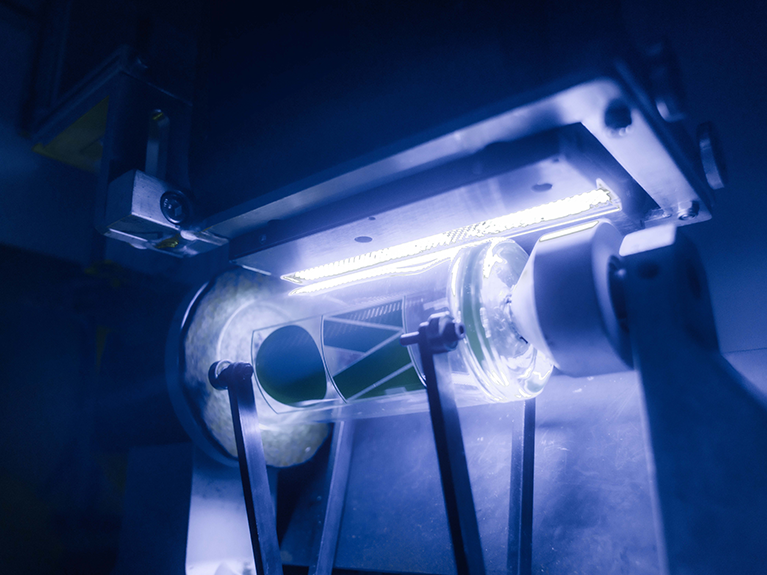
In general, good UV-curing is always dependent on the quality of the ink and the UV-curing equipment. The status of the UV-curing equipment should be checked prior to modifying the UV ink with auxiliaries for the intended purpose.
Parameters to check
- Status of the UV lamps (operating life < 1000 h)
- Status of the reflector to determine whether the mirrors are clean and in good condition
- Correct focusing of the lamps and the distance between UV-lamps and substrate surface
- Control of belt speed to establish regularity and correct adjustment
We further recommend a UV-curing unit with two lamps for pigmented UV inks. An exception here are multi-colour machine systems such as those used for ODs, printing onto 3D objects, or labels, or if the UV-lamps have an output of 120 W/cm (300 W/inch) or more. Each ink film should be fully crosslinked, based on the 80 % method, and must pass the crosshatch-tape test directly after curing and cooling to room temperature.
There is a tendency to assume that poor adhesion is due to inadequate curing. Whilst poor curing will cause adhesion failures, it must be noted that incorrect ink choice, poor ink application, and (more often) poor surface pre-treatment will dramatically reduce adhesion. In this case, by simply increasing the effectiveness of the cure, poor adhesion will not be eliminated, and in some instances can actually make the situation worse, as the ink film may become brittle.
2. ACCELERATION OF UV-CURING
There are various ways of accelerating UV-inks:
a. Change-over to a faster curing ink system.
b. The addition of 10-20 % special binder will reduce the opacity of the ink, accelerating the reactivity of the UV-ink.
c. The addition of 3-5 % UV-Thinner will reduce the ink´s viscosity, leading to a thinner ink film, which can be cured much easier. Some UVThinners are highly reactive and may also contain photo initiators which additionally increase the curing speed.
d. If only the reactivity needs to be increased, we recommend the addition of a UV accelerator.
Accelerator UV-B 1
UV-B 1 is a photoinitiator, which can be added and homogeneously mixed to the ink at a concentration of 0.5-2 %. UV-B 1 neither causes yellowing, nor a pot life. It accelerates the reactivity of the ink and at the same time improves the ink´s adhesion by a better deep curing.
Accelerator UV-B 2
UV-B 2 increases the reactivity of the photoinitiator already part of the ink formulation. This improves the curing speed of the ink and at the same time increases the gloss level, surface hardness and thus, the blocking and water resistance of the printed ink film. UV-B 2 is added to the ink at a concentration of 1-4 % by weight, neither causing yellowing of the ink, nor a pot life.
Accelerator UV-B 3
Suited for sensitive applications, UV-B 3 accelerates the reactivity, and can be added and homogeneously mixed at a concentration of 1-4 %. UV-B 3 neither causes yellowing, nor a pot life.
Accelerator UV-B 4
UV-B 4 accelerates the reactivity of LED-curable inks and can be added and homogeneously mixed at a concentration of 1-4 %. UV-B 4 neither causes yellowing, nor a pot life.
Accelerator UV-B 5
UV-B 5 accelerates the curing speed of the ink and at the same time increases the gloss level, surface hardness and thus, the blocking and water resistance of the printed ink film. UV-B 5 is added to the ink at a concentration of 0.5-4 % by weight and neither causes yellowing, nor a pot life.
3. VISCOSITY
Viscosity describes how thin (low viscous) or thick (highly viscous) an ink system is or how it is adjusted. Depending on the application and segment, the ink´s consistency may be adjusted so that it is thinner (lower viscosity) e.g. for rotary screen printing or thicker (higher viscosity) for printing onto optical discs.
A suitable thinner is added at a concentration of usually 1-5 % to reduce the viscosity of the ink.
Basic shades are always adjusted to a relatively similar viscosity range, with two exceptions:
- Due to high pigment levels in White, Opaque Whites, and high-opaque shades, the viscosity is always higher than all other shades
- 4-colour process inks feature a higher viscosity than the basic shades in order to ensure best dot definition
Thinner UVV 1
- UVV 1 is a mix of monomer and photoinitiator
- The addition will reduce viscosity and increase the ink´s reactivity at the same time
Thinner UVV 2
- UVV 2 is a mix of monomers, leading to a reduced viscosity
Thinner UVV 3
- UVV 3 is a mix of HDDA-free and high-reactive monomers with photoinitiator
- The addition will reduce the viscosity and increase the reactivity at the same time
- The higher cross-linkage may also produce a better chemical and mechanical resistance
Thinner UVV 5
- UVV 5 is a HDDA-free mix of monomers to reduce the viscosity • May increase flexibility (not approved in the US)
Thinner UVV 6
- UVV 6 is a mix of monomers
- The addition will reduce the viscosity and may increase the flexibility of the ink
The addition of the above described UV-Thinners does not have a yellowing effect on the colours. Caution: The ink film tends to have a strong odour if not completely cured.
4. THIXOTROPY
The terms “rheology” and “thixotropy” describe the flow properties of printing inks. Each ink series is optimized to the intended use, but can be modified by the addition of suitable auxiliaries.
Thickening Agent UV-TA 1
This liquid thickening agent will increase the ink’s thixotropy and improves the print definition with an addition of 0.1-0.5 %. UV-TA 1 can be combined with the Thickening Agent STM. Attention: can only be used in selected ink series, see Technical Data Sheets.
Thickening Agent STM
Thickening agent STM is a thickener in powder form which significantly increases viscosity and thixotropy of a printing ink (reduced flow ability) if 1-2 % are added. This addition is useful for printing very fine details in positive and reverse printing, for haptic effects (thick ink film is desired), and when printing onto absorbent materials, e.g. uncoated papers. STM must not be added for deep-drawing or other applications requiring a high flexibility.
It is important that STM is homogenized for approx. 5–10 minutes using a stirrer, or preferably a shaker. This is essential to retain the gloss level of the ink. Mixing by hand using a spatula is insufficient for this purpose.
5. MATTING
In contrast to solvent-based inks, the matting of UVcuring systems is rather difficult owing to the 100 % solid formulation. Without the volatile components, the ink film will not shrink during the curing process, and as a result matting powders cannot stick out of the ink film creating a matt surface. We recommend the use of our matt ink series Ultra Star-M UVSM.
6. INK LEVELLING
Ink systems contain levelling agents in the basic formula reducing the trapped air in the form of air bubbles as a result of squeegee movement or when stirring. Levelling defects may be caused when the ink´s viscosity is too high for the individual printing conditions. The following possibilities are recommended to solve levelling problems:
- Homogeneous stirring of the ink so that the contained flow agents are properly mixed
- Ink flow can be improved by reducing the viscosity with the addition of 1-5 % thinner
- Addition of 0.5-1.5 % of Levelling Agent UV-VM
- Pre-cleaning of the substrate with the Cleaner PLR (see Chapter 9)
Levelling Agent UV-VM
With a few exceptions, UV-VM can be used in all UV ink series considering the following:
- UV-VM causes a slight blur in varnishes and generally reduces the gloss level of the ink
- Overdosing of UV-VM causes ink adhesion problems in overprinting
- UV-VM must not be added to silicone-free inks
Printing onto soft vinyl (PVC)
Soft vinyl is heavily loaded with plasticizers that are chemically unlinked within the material (10-40 %) and likely to settle on the material surface. This will generally result in insufficient flow properties and possible ink adhesion problems. Pre-cleaning with an alcohol-based cleaner such as PLR is mostly the only solution to take off the excessive plasticizers on the substrate surface (see chapter 9).
7. FLEXIBILITY
There are no corresponding additives for UV-curing inks equivalent to the plasticizing agents that are available for solvent-based inks to make the ink system notably more flexible. The addition of UVV 5 or UVV 6 may slightly increase the ink’s flexibility. It is important that the correct ink type is chosen from the start.
Comparison of flexibility
Very flexible: e.g. UVFM, UVSW
Flexible: e.g. UVS, UVAR
Less flexible: e.g. UVC, UVOD, UVP, UVRS, UVSP, UVSM
Not flexible: e.g. UVK+
Please refer to the Technical Data Sheets for information on the flexibility of other ink series.
8. ADHESION MODIFIER
The addition of adhesion modifiers to UV inks can often improve the ink´s adhesion to difficult substrates, and improve its chemical and mechanical resistance. Maximum adhesion and resistance is achieved after 24 h.
Adhesion Modifier UV-HV 1
- Recommended addition is 0.5-2 %
- For printing onto coated papers, metals or varnished surfaces, not suited for plastics
- Can be used with UVP and UVS
- Pot life ca. 8 h
Adhesion Modifier UV-HV 4
- Recommended addition is 0.5-4 %
- For printing onto difficult surfaces, e.g. metals, varnished surfaces, some plastics, partly glass
- Can be used with UVP, UVS, and UVSM
- Pot life ca. 2-4 h
Adhesion Modifier UV-HV 7
- Recommended addition is 1.5-10 %, depending on the colour shade
- For printing onto glass, a post-treatment at 160 – 180 °C for 30 minutes is mandatory
- Can be used with UVP
- Pot life ca. 8 h
Adhesion Modifier UV-HV 8
- Very good initial adhesion!
- Recommended addition is 2-4 %, depending on the colour shade
- For printing onto glass or metals
- Can be used with UVGL, UVG3C
- Pot life ca. 8 h
Note: Depending on product and quantity added, best results will be achieved after 12-24 h.
Hardener H 1
- Recommended addition is 2 % to UVSM to improved adhesion
- Pot life 6-8 h
Hardener H 2
- Recommended addition is 2-4 % to UVGX for improved adhesion and resistance
- Pot life 6-8 h
Hardener H 3
- Recommended addition is 2-4 % for improved adhesion and resistance of UVC, UVK+, UVPHR, and LEDC.
- Pot life 6-8 h
General information on hardeners
All hardeners are sensitive to humidity. Therefore, the drying process must take place at the lowest possible ambient humidity in the first 24 hours, otherwise parts of the hardener will react with the water instead of the ink. During storage of the hardener any contact with humidity must also be strictly avoided (containers must always be completely closed after use!). Best results will be achieved after 24 h.
9. PRE-CLEANING
Many materials such as plasticized PVC or powder coated or wet painted substrates are invisibly contaminated by additives or plasticizers. This contamination may act as a separation layer and lead to adhesion problems due to a lack of contact between substrate and print.
Tarpaulin Cleaner PLR
Using this mild alcohol-based cleaner, residues can be removed with a cloth soaked in PLR, often resulting in better ink adhesion. Please change the cloth from time to time.
10. FURTHER AUXILIARIES
Hot Stamping Additive UV-HS 1
- Recommended addition is up to 10 % to UVGL Primers
- Allows hot foil stamping at lower temperatures
Surface Additive UV-SA 1
- Recommended addition is up to 0.3-1 %, specifically in container printing
- UV-SA 1 will permanently increase surface stability. It creates a smoother surface leading to a higher gloss level and better abrasion resistance
The addition will not cause a pot life, however, it can cause adhesion problems in overprinting
11. REMARK
Besides the regular addition of thinner or hardener, further modification of the ink with auxiliaries should be well-considered. Auxiliaries show their positive effect only if added in the adequate quantity. Please refer to the Technical Data Sheets for quantity indications. The quantities are based on percentage by weight and not by volume. Overdosing will in most cases adversely affect the printing results and will lead to difficulties such as levelling problems or loss of adhesion, especially for multicolour prints. For these reasons, a scale and accurate working are a necessity. Any addition of an auxiliary will change the characteristics of the respective ink system. Preliminary trials are always essential.
Contact
In the event of any queries, please contact:
Technical Hotline
Phone: +49 7141 691140
technical.hotline[at]marabu.de